
By The MAES Production Team | Est. Read Time: 8 Minutes
The Australian activewear market is one of the most competitive in the world. For new brands, the difference between success and failure often comes down to one decision: who manufacturers your product. Many brands seek private label activewear manufacturers in Australia to achieve lower costs without sacrificing quality.
If you are searching for private label activewear manufacturers serving Australia, you have likely encountered the “Goldilocks Dilemma”:
- Local Australian Manufacturers: High quality, but often cost-prohibitive ($40+ AUD cost per unit), crushing your margins.
- Generic Alibaba Factories: Cheap, but plagued by “Asian Fit” sizing issues and inconsistent fabrics.
We wrote this guide to give you a third option. As a factory-direct team (MAES) that specializes in the Australian market, we are going to open-source our knowledge. Here is exactly how to vet a manufacturer that understands the Australian landscape.
At a Glance: The Sourcing Decision Matrix
(Quick Comparison for Busy Founders)
| Feature | Local Aus Manufacturer | Generic Overseas Factory | MAES (Factory Direct) |
| Cost Per Unit (Leggings) | High ($35 – $60 AUD) | Low ($8 – $12 USD) | Mid-Range ($14 – $19 USD) |
| MOQ (Min Order Qty) | Very Low (20-50 units) | High (300-500 units) | Startup Friendly (100 units) |
| Sizing Standard | True Aussie Fit | Often “Asian Fit” (Too small) | Calibrated Western/Aus Block |
| Shipping Terms | Local Courier | FOB (You handle Customs) | DDP (We pay Duty & Customs) |
| Best For… | Ultra-luxury / Boutique runs | Price-fighting commodity brands | Scaling Startups & Mid-Tier Brands |
Part 1: Decoding the Labels – Private Label vs. White Label vs. Full ODM
Before you start contacting factories, it is crucial to understand what you are asking for. The terms “Private Label,” “White Label,” and “ODM” are often used interchangeably, but they mean very different things for your budget and timeline.
Private label manufacturers can produce a range of products, including gym wear, to suit different brand identities and market needs.
Here is a breakdown of the three main manufacturing models available to Australian brands:
1. White Label Activewear (The “Generic” Route)
Think of this as buying a blank t-shirt from Kmart and printing your logo on it.
- What it is: You purchase wholesale activewear (or “blanks”) that are pre-made and sitting in a warehouse. You simply add your brand’s logo.
- Pros: Very fast (1-2 weeks), extremely low minimums.
- Cons: Zero differentiation. Your competitors can buy the exact same leggings. You have no control over the fit, fabric, or design. If the fit is bad, you can’t fix it.
- Best for: Gyms selling merch to members, not fashion brands.
2. Full ODM / Custom Manufacturing (The “High-Risk” Route)
This is building a house from scratch without an architect.
- What it is: This is full custom activewear manufacturing. You provide everything: technical sketches, fabric sourcing, size charts, and pattern files. The factory just follows your instructions blindly.
- Pros: 100% unique product.
- Cons: Extremely high barrier to entry. If you don’t know the difference between “flatlock” and “overlock,” or if your tech pack has a 1cm error, the factory will make it wrong, and you still have to pay for it. High development costs and longer lead times.
- Best for: Established brands with an in-house design team.
3. Private Label (The “Smart Hybrid” Route)
Private label manufacturers typically offer a wide range of sportswear options that can be customized to reflect your brand.
- What it is: The manufacturer provides a library of pre-developed, high-quality styles (pattern blocks) that are proven to fit well. You then “customize” these bases.
- Your Control: You choose the fabric, the colors, the logo placement, and small design tweaks (e.g., “remove the back pocket” or “make the waistband 1cm higher”).
- Pros:
- Lower Risk: You are using patterns that have already been tested on real bodies.
- Speed: Skip the 3-month pattern-making phase.
- Brand Identity: Unlike White Label, you choose the specific fabric and colors, making the product feel uniquely yours.
Part 2: The “Australian Fit” Problem (And How to Fix It)
The #1 reason Australian brands fire their overseas manufacturers is sizing.
Scaling up an Asian “Medium” to an Australian “Large” does not work.
The “Vertical Grading” Trap
Asian anthropometric data typically shows a different torso-to-leg ratio compared to the average Australian consumer.
- The Error: Generic factories just make the waist wider for larger sizes.
- The Result: The “Ankle Gap” (leggings are too short) and the “Squat Slide” (waistband isn’t high enough in the back).
The Technical Solution
You must ask your manufacturer if they use Western Grading Rules.
At MAES, our patterns feature:
- Increased Rise Depth: We add 1.5cm+ to the crotch depth per size up, ensuring coverage for taller torsos.
- True AU 10 Standard: Our “Medium” is calibrated to a standard Australian Size 10/12, not a US 4 or Asian XL.
Pro Tip: Never pay for a full bulk order until you have fitted a sample on a real human model in Australia, not just a mannequin.
Part 3: The Technical Deep Dive – How to Evaluate Manufacturing Expertise
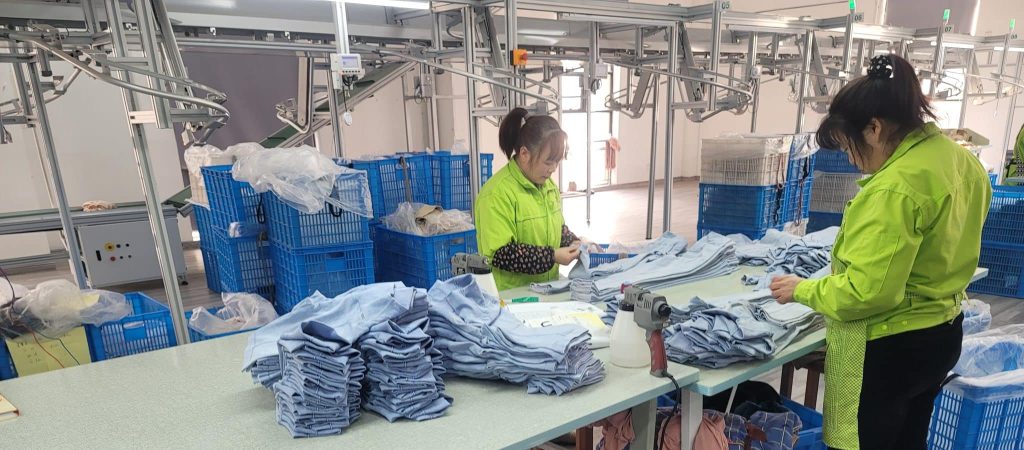
Not all clothing factories can make quality activewear. A facility might excel at basic cotton tees but completely fail at performance leggings.
Most manufacturers will simply quote “80% Nylon, 20% Spandex.” But to a professional buyer, that tells you almost nothing. If you want to compete with Lululemon or Lorna Jane, you need to look at the microscopic details.
Here is the technical checklist we use at MAES, which you can use to vet any potential supplier.
3.1 Fabric Science: Beyond the Basics
Don’t just ask what the fabric is; ask how it performs.
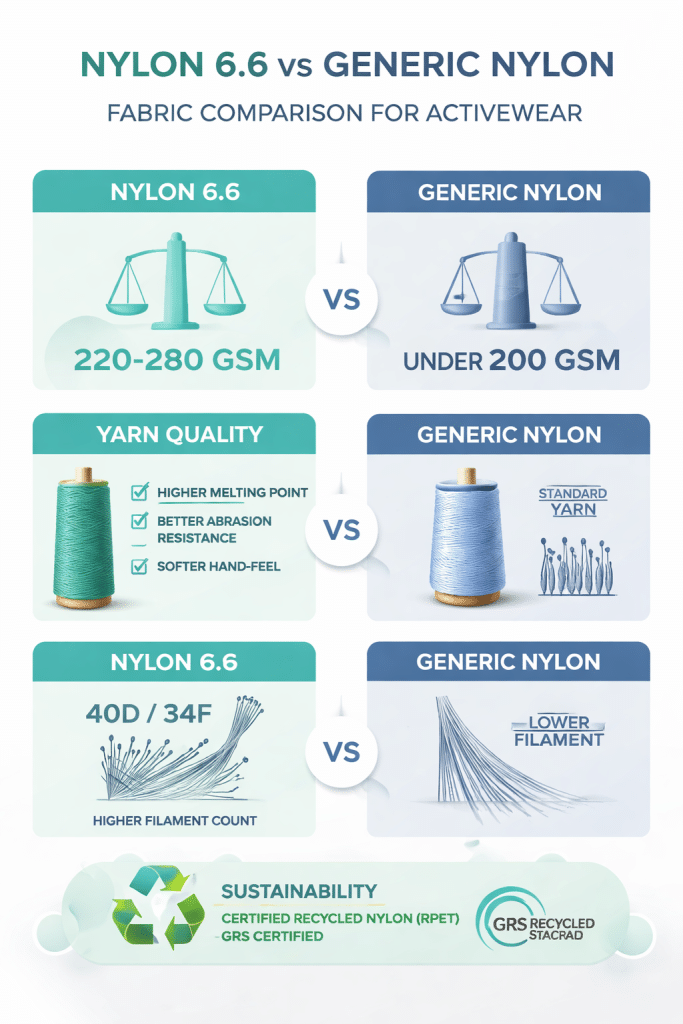
- The Weight (GSM) Sweet Spot
- The Standard: For squat-proof leggings, look for 220gsm to 280gsm.
- Why it matters: Anything under 200gsm is usually lingerie quality (too thin). Anything over 300gsm is too hot for the Australian climate.
- Yarn Quality: The “Nylon 6.6” Difference
- The Trap: Cheap factories use generic Nylon 6, which feels plasticky and holds heat.
- The Solution: Demand Nylon 6.6. It has a higher melting point, better abrasion resistance, and a softer hand-feel.
- The Secret to “Buttery Softness”
- Softness isn’t magic; it’s math. It comes from the Filament Count.
- At MAES, we use high-filament yarns (e.g., 40D/34F). This means more tiny fibers per thread, creating that “brushed” nude feel physically, rather than relying on chemical softeners that wash out after 5 cycles.
The Sustainability Factor
“Greenwashing” is illegal in Australia. If you claim your product is recycled, you need proof.
- What we use: Certified Recycled Nylon (rPET) and Biodegradable packaging.
- The Proof: Always ask for the GRS (Global Recycled Standard) certificate for the specific fabric batch.
3.2 Construction: The “Squat-Proof” Architecture
How do you spot a premium manufacturer from a photo? Look at the seams.
- Stitching: The Gold Standard
- Requirement: Four-Needle Six-Thread (Flatlock).
- Benefit: It creates a completely flat seam that doesn’t chafe during a run. If a factory offers “Overlock” for leggings, they are cutting corners.
- The Gusset (No More Camel-Toe)
- A gusset is the diamond-shaped insert in the crotch area.
- MAES Standard: Our gussets are pattern-engineered into the block, not just patched on. We ensure they extend far enough forward to actually function, using the same performance fabric as the leg panels.
3.3 Lab Testing: Trust, But Verify
Any factory can say their leggings are “squat-proof.” Professional manufacturers prove it.
When sourcing for the Australian market (high UV, outdoor lifestyle), ask for these three test reports:
- The Squat Test (Opacity)
- We perform a 4-way stretch opacity test where fabric is stretched to 40% extension under standardized lighting. If we can see the testing card underneath, the batch is rejected.
- Pilling Resistance (Durability)
- Premium activewear must score Grade 4 or higher on the Martindale scale (10,000+ rubs). This ensures thighs don’t pill after a month of gym use.
- Color Fastness (Aus Sun & Chlorine)
- Australian activewear endures intense sun and frequent washing. We test for Light Fastness (UV resistance) and Chlorine Resistance to ensure your blacks stay black, not charcoal grey.
Part 4:The Logistics Trap – Shipping & Duties to Australia
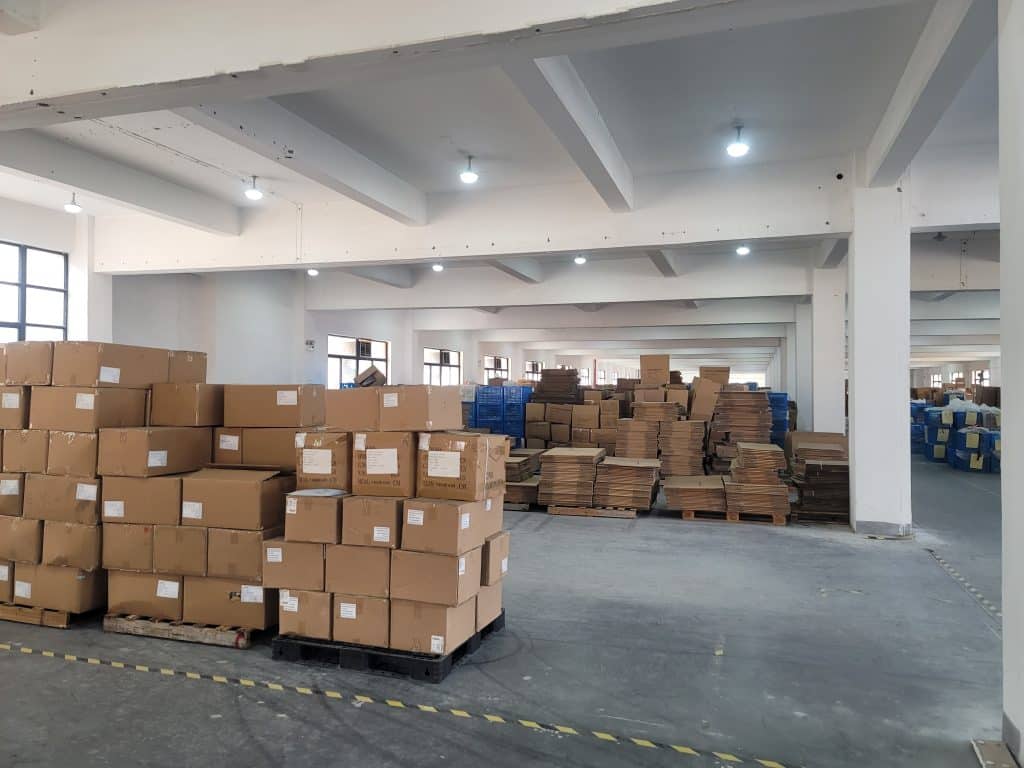
One of the most overlooked aspects of choosing private label activewear manufacturers for Australia is logistics. Many startups calculate the product cost but forget the landed cost (the total cost to get the product to your door).
Many Australian brands avoid overseas manufacturing because they’re intimidated by:
- Customs clearance procedures
- GST and duty calculations
- Choosing freight forwarders
- Dealing with delays at the border
If your manufacturer is based overseas, you need to navigate Australian Customs. This is where the difference between FOB and DDP becomes critical.
Understanding the Terms:
- FOB (Free on Board): The factory puts the goods on a boat, and their responsibility ends there. You are responsible for insurance, hiring a freight forwarder, clearing customs, and paying import duties yourself.
- Risk: Hidden costs and paperwork headaches.
- DDP (Delivered Duty Paid): The “stress-free” option. The manufacturer handles everything—shipping, customs clearance, and duty payments—until the boxes arrive at your door in Sydney, Melbourne, or Brisbane.
- Benefit: You know the exact final price upfront. No surprise bills.
Our Advice: For most startups, we strongly recommend negotiating DDP terms. At MAES, we offer this standard to our Australian clients to ensure seamless delivery, but regardless of who you work with, ask for this to protect your margins.
Cost Comparison:
For a 500-piece order of leggings:
- Without DDP: You pay factory cost + scramble to arrange shipping + get hit with unexpected $800 customs bill
- With MAES DDP: One clean invoice, goods arrive at your door, you focus on selling
Part 5: What a Professional Production Process Looks Like——The Production Timeline & Process
Many startups assume manufacturing is as simple as “send a sketch, get a sample.” In reality, a successful launch follows a strict technical roadmap.
Understanding the timeline is crucial for planning your launch date.
Speed to Market: The Typical Timeline
- Phase 1: Sampling (2-3 Weeks)
Includes pattern making, sourcing fabrics, and creating the first prototype. - Phase 2: Revisions (1-2 Weeks)
Tweaking the fit based on your feedback. - Phase 3: Bulk Production (4-5 Weeks)
Cutting, sewing, quality control, and packing. - Phase 4: Shipping (5 Days – 5 Weeks)
- Air Freight: 5-7 days (Recommended for first launch)
- Sea Freight: 4-5 weeks (Recommended for restocks)
The 8-Step Production Protocol
Whether you work with us or another supplier, you should expect your private label activewear manufacturer to follow this specific protocol. If they skip steps (especially Step 2 or 6), it’s a red flag.
Phase 1: Pre-Production
- Step 1: The “Feasibility” Brief: Before quoting, a good factory will ask about your target price point and market positioning. (e.g., Are you selling $60 leggings or $120 premium leggings? This dictates the fabric choice).
- Step 2: The Tech Pack & Digital Grading: Never proceed without a Tech Pack. This is the blueprint that defines your measurements for every size (XS to XL).
- The Standard: Ask your manufacturer if they handle “grading” (scaling sizes) specifically for the Western market.
- Step 3: Lab Dips & Swatches: You should receive fabric swatches to feel the “hand-touch” and approve colors under natural light before any sewing begins.
Phase 2: Sampling (The “Iterative” Phase)
- Step 4: The Prototype: You receive the first physical sample.
- Reality Check: The first sample is rarely perfect. Expect 1-2 rounds of revisions to tweak the fit (e.g., “tighten the waistband by 1cm”).
- Step 5: The “Golden Sample”: Once approved, this sample is sealed and signed. This becomes the “contract” for bulk production.
Phase 3: Bulk & Delivery
- Step 6: Pre-Production Sample (PPS): A crucial safety net. The factory makes one final unit using the actual bulk fabric and trims. You must sign this off before they cut the fabric for 500 units.
- Step 7: Mass Production & QC: Quality control shouldn’t just happen at the end. It should be “in-line” (during sewing).
- Step 8: DDP Shipping: The goods are shipped, customs cleared, and delivered to your door.
Part 6: Risk Management – Protecting Your Brand
The biggest fear for any founder is paying a deposit and receiving unsellable products. Instead of relying on blind trust, you should demand contractual protections.
Here are the hard questions you need to ask any potential manufacturer:
1. “What is your Defect Policy?”
A zero-defect rate is impossible in textile manufacturing. However, there is an industry standard.
- Acceptable Standard: A defect rate under 2% is normal.
- The Protection You Need: Your agreement should state that if defects exceed 2%, the manufacturer will provide free replacements or credit.
- Note: Be wary of factories that offer “no refunds, no exchanges” policies.
2. “How do you protect my Intellectual Property (IP)?”
You spend months designing a unique pattern. The last thing you want is to see it on a competitor’s site.
- The Solution: Ask for a Non-Disclosure Agreement (NDA).
- Pattern Ownership: Clarify who owns the patterns. If you pay for custom pattern development, you should own the digital files.
3. “How do you ensure consistency?”
The classic “Bait and Switch”—the sample is great, but the bulk order uses cheaper fabric.
- The Fix: Implement a “Sealed Sample” system. You keep one signed sample, and the factory keeps one. If the bulk arrival doesn’t match the sample, you have grounds for a claim.
Frequently Asked Questions (Australia-Specific)
Q: What is a realistic Minimum Order Quantity (MOQ) for a startup?
A: Traditional factories often demand 500+ pieces per colour. However, specialized private label activewear manufacturers for Australia (like MAES) often lower this to 100-200 pieces to help brands test the market.
Q: Should I use Air Freight or Sea Freight?
A: For your first launch, we often recommend Air Freight (10-15 days). It is more expensive, but getting your product to market 4 weeks earlier allows you to generate cash flow and gather customer feedback sooner. Use Sea Freight for restocks.
Q: Do I need an Import License to buy from overseas?
A: If you choose DDP Shipping (Delivered Duty Paid), the answer is no. The manufacturer acts as the importer of record. If you choose FOB, you may need an ABN and to hire a customs broker.
Q: Is MAES Right for Your Stage?
Honesty saves time. We are a specialist solution, not a budget commodity supplier.
We might NOT be the right fit if:
You are looking for the absolute lowest price per unit (e.g., under $8 USD leggings) to compete with fast fashion.
You need 'Print on Demand' dropshipping (one unit at a time).
However, we ARE your ideal partner if:
You are building a mid-to-high-end brand (Retail $80+ AUD).
You value DDP shipping to avoid customs headaches.
You need specific Australian sizing validation.
Conclusion: Your Manufacturing Partner, Not Just Your Supplier
The Australian activewear market is competitive but full of opportunity for brands that nail the fundamentals: superior fit, quality fabrication, and authentic brand storytelling.
The manufacturing partner you choose becomes invisible to your customers but defines everything about their experience with your brand. Choose a partner who:
✅ Understands Australian Bodies – Not just Asian sizing scaled up, but true Western fit development
✅ Offers Flexibility – Low MOQs that let you test and iterate without betting the farm
✅ Removes Friction – DDP shipping that makes international sourcing feel local
✅ Proves Quality – Through testing, certifications, and transparent communication
✅ Grows With You – From your first 100-piece order to your first 10,000-piece reorder
At MAES, our role goes beyond sewing machines. We aim to be the technical partner that allows you to compete with major global brands on quality, while maintaining the agility of a startup. While your competitors are stuck with generic products from commodity suppliers or priced out by local manufacturers, you’ll have custom-designed, perfectly-fitted activewear that your customers will rave about. While many founders initially look to private label activewear manufacturers in the USA, choosing a production partner specifically calibrated for the Australian market offers a distinct competitive advantage.
MAES helps Australian brands compete and stand out in the world of activewear, ensuring your products are ready for success on a global stage.
The Australian activewear boom isn’t slowing down. The only question is: will your brand capture its share?
Ready to Start Your Brand Journey?
Don’t let analysis paralysis delay your launch. Every day you wait is another day your competitors are building customer loyalty.
Take the first step today:
- 📥 Download Our Free Catalog – See pricing, styles, and fabric options (no obligation)
- 💬 Book a Free 30-Minute Consultation – Share your vision, get expert advice
- 📦 Order Your First Sample – Experience MAES quality firsthand
Contact MAES Today:
- WhatsApp: +86 18668366822
- Email:
- Website: https://allactivewear.au/
About the Author: The MAES Production Team
With over 10 years of experience in textile engineering, the MAES team specializes in manufacturing premium activewear for the Western market. We bridge the gap between technical manufacturing and brand building, helping 50+ Australian startups launch successfully.