
Australian buyers who ask about recycled fabric activewear tend to raise the same three concerns. First, does recycled polyester (RPET) hold up in a 38°C Brisbane summer, or does it fall short of virgin synthetics on breathability? Second, will the wording on the hang tag survive ACCC scrutiny? Third, will a “sustainable” range leave the brand holding dead stock?
This guide answers each concern with test standards, label wording and order-quantity arithmetic. It is written by the engineering team at CFC Activewear. We manufacture in our own factory in China, so the specifications below come from the production floor and not from a sales deck.
Performance Reality: RPET vs. Virgin Synthetics in the AU Climate
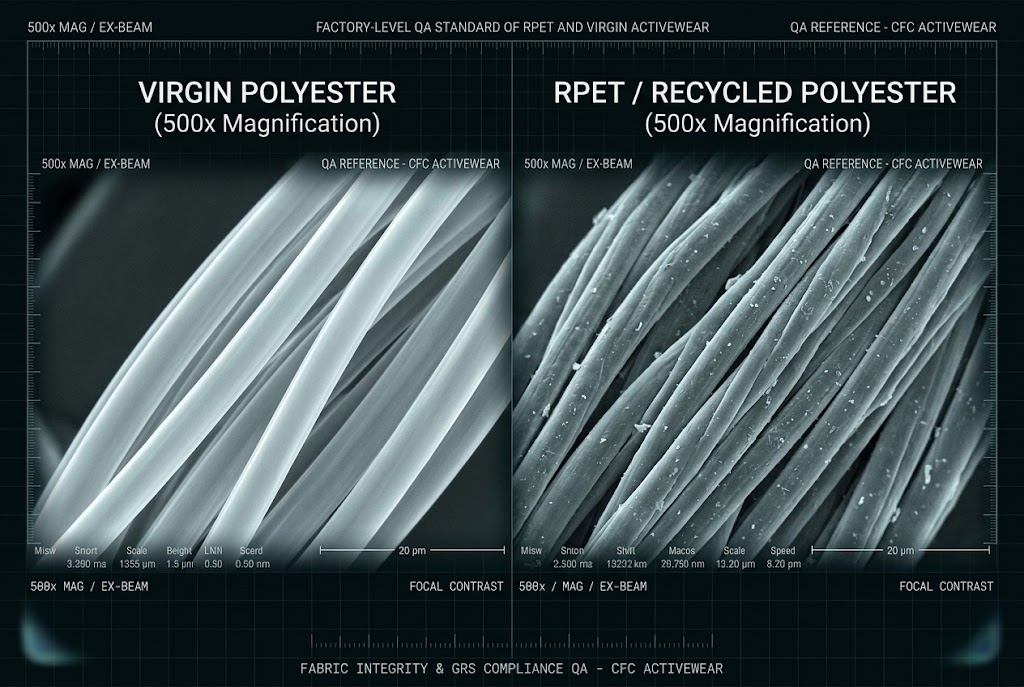
Recycled polyester made from post-consumer plastic bottles is the same polymer as virgin PET. Where RPET and virgin fabric differ in performance, the cause is almost always yarn quality, knit construction or finishing. The recycled origin is rarely the cause. Buyers should therefore judge a fabric on its measured data. Generic words like “breathable” or “quick-drying” tell you nothing about how it will behave in Australian conditions.
Measure vapour transport, not just airflow
Air permeability (ASTM D737) shows how much air passes through a fabric. It does not show how well sweat vapour leaves the skin during a humid Queensland session. For that you need Moisture Vapor Transmission Rate (MVTR) under ASTM E96. Ask every supplier for both figures on the exact bulk fabric, not on a catalogue sample. Two fabrics with the same GSM can return very different MVTR results, because knit structure, yarn denier and finishing chemistry all change vapour transport.
Control pilling before it reaches your customers
Recycled yarns can carry a slightly higher short-fibre content, depending on the grade of chip and the spinning process. That raises abrasion risk in high-friction zones such as inner thighs, underarms and under-bust panels. We use the ASTM D3512 random tumble pilling test to screen RPET fabrics. As a buyer specification, we recommend a minimum rating of grade 4. Test laundered specimens as well as fresh fabric, because pilling on a high waist legging often shows up after the third or fourth wash, not on day one.
Colour and shrinkage are process problems
Batch shade variation and shrinkage drift come mainly from inconsistent heat-setting and dye-bath conditions. At CFC Activewear, RPET and elastane blends go through controlled dyeing and heat-setting. Dimensional change is checked after laundering (ISO 6330). Finished garments then go through our 5-stage inspection, with a final AQL 2.5 audit. This keeps bulk production close to the approved sample. We recommend writing three limits into your purchase order:
- A delta E limit against the approved lab dip.
- A shrinkage limit (±3% is a common benchmark).
- A reference to the signed-off PP sample as the acceptance standard.
RPET vs. recycled nylon: a quick comparison
Brands often ask whether recycled nylon is the better choice for sportswear. The answer depends on the garment.
RPET suits most standard activewear. Recycled nylon earns its place where compression, stretch recovery or aquatic crossover matter. If your range includes both, specify each fabric’s MVTR and colourfastness data separately.
Navigating the ACCC: How to Make Legal Environmental Claims
Under the Australian Consumer Law (ACL), an environmental claim must be accurate, specific and backed by evidence. The ACCC has pursued greenwashing matters across many industries, and fast fashion and activewear brands are firmly in its field of view. A penalty can follow from a single misleading claim on a hang tag, a product page or an Instagram caption.
Where brands get caught
The most common mistake is overstating recycled content. If a garment contains 20% recycled fibre and the label says “100% recycled”, the claim is misleading. The same risk applies when a product is labelled “100% recycled” but the elastane, trims, zips or labels are virgin material. Unqualified terms such as “eco-friendly”, “sustainable” or “planet-friendly” are also risky, because they imply a broad environmental benefit that is hard to substantiate.
Compliant wording
Main fabric: 78% GRS-certified recycled polyester, 22% elastane.
This wording works because it states the percentage, the material, the certification and the part of the garment it covers. Three further habits help:
- Make claims about the product, not about your brand’s whole footprint.
- State what was recycled (for example, post-consumer plastic bottles) only if your documents support it.
- Avoid “recyclable” unless a collection and textile recycling pathway exists for that specific blend. Elastane blends are hard to recycle at scale today.
The evidence file matters as much as the wording
Every bulk order from CFC Activewear can come with a GRS Transaction Certificate (TC). It documents the certified recycled content for that shipment, and our material records separate pre-consumer from post-consumer inputs. If the ACCC, a competitor or a journalist questions your claim, you can produce the document immediately. We also hold OEKO-TEX® Standard 100 certification for chemical safety, which is a separate claim from recycled content and should not be blended with it on a label. For performance claims such as UPF 50+, test to AS/NZS 4399 and keep the independent laboratory report on file.
A note on environmental numbers
Reductions in greenhouse gas emissions and water use for recycled polyester are reported in life cycle assessments (LCAs), but results vary by study, region and energy source. Do not quote a percentage on your website unless you can cite the source and scope. If you want to make a lower-environmental-impact claim, ask your supplier for the specific data behind it.
The ACCC requires you to substantiate a claim, and a certificate on its own is not a legal safe harbour. We recommend getting legal advice on your final wording.
De-risking Your Supply Chain: True Costs & MOQs
Recycled fabric costs more per metre, typically an 8–18% material premium. But fabric is one line in the cost of a garment. After cutting, sewing, trims, packaging and labour, the finished garment cost usually rises by only 4–10%. On a legging with a typical wholesale price, that increase is small next to the cost of an unsold carton.
Where the real risk sits
The larger risk is minimum order quantity. Fabric mills often set high minimums for certified recycled yarns, and that pushes small brands into ordering far more than they can sell. We run our own factory (12,000 m², 180+ staff, 2.5 million pieces of annual capacity) and hold GRS-certified RPET/spandex blends. This lets us run custom cut and sew orders at 100–200 pieces per colour. Sampling takes 8–15 days, and bulk cut and sew production takes 25–35 days. Seamless garments need 450–500 pieces per style and take 40–45 days. If you need to test the market first, stocked items are available from one piece, and stock samples take 2–3 days.
To see how these GRS-certified materials are cut, sewn, and quality-controlled in our facility, explore our full capabilities as a trusted Sustainable Activewear Manufacturer Australia.
Keeping 100–200 piece orders consistent
Low quantities increase the risk of inconsistency, so the approval sequence must be rigid:
- Development sample, to confirm pattern, fabric and construction.
- Pre-production (PP) sample, which becomes the legal and technical reference for bulk.
- Top of production (TOP) sample, pulled from the first finished units.
Keep one sealed reference unit for 12 months. For seam integrity, specify four-needle six-thread flatlock on stress zones. Our Juki and Pegasus machines are set up for it, and tension is a major-defect category in the AQL 2.5 inspection.
Protecting cash flow
Landed cost, not FOB price, decides your margin. Include freight, insurance, import duty, customs clearance and inbound logistics before you set RRP. To limit inventory risk on the first drop:
- Restrict the range to 1–2 core silhouettes.
- Limit colourways to those with proven demand.
- Reorder winners in small tranches instead of overcommitting upfront.
Request RPET Fabric Samples & Test Data
Send us your target garment, fabric weight and colour range. We will match it to GRS-certified RPET options and share the available MVTR, pilling and colour fastness results for each. Physical swatches ship directly from China to Australia. Custom orders start at 100–200 pieces per colour, with 8–15 day sampling.
FAQ
Q1: How should Australian activewear brands choose between RPET, recycled nylon, and blended fabrics for summer breathability, sweat management, and UV protection?
For Australian summer conditions, select RPET (220–240 GSM) for standard gym wear and recycled nylon for high-compression or aquatic crossover garments. Never rely on generic “quick-dry” claims. For quantifiable sweat management, demand Moisture Vapor Transmission Rate (MVTR) testing via ASTM E96, alongside standard Air Permeability testing (ASTM D737). If claiming UPF 50+, you must mandate AS/NZS 4399 standard testing. At CFC Activewear, we engineer our GRS-certified fabric blends specifically for the AU climate, conducting essential MVTR and colour fastness tests before initiating your 100–200 piece custom order.
Q2: What size tolerances, fit tests, and squat-proof acceptance criteria should Australian brands set for RPET leggings and sports bras?
Standardise your tech packs with a maximum sizing tolerance of ±1.5 cm for AU 6–26 specifications, and mandate physical stretch-opacity testing over static GSM checks. True squat-proof verification requires testing the fabric at maximum stretch under standard lighting conditions, especially for light colours, both before and after 5 wash cycles. For sports bras, you must strictly differentiate patterns between low, medium and high-impact support rather than scaling a universal block. Operating under a strict AQL 2.5 standard, CFC Activewear runs multi-stage fit sessions and opacity checks to catch sheer-out across your size run.
Q3: How should Australian activewear brands manage sampling, AQL 2.5 inspection, and production consistency when ordering 100–200 custom pieces from China?
Control low-MOQ consistency by locking in a rigid approval sequence: Development Sample → Pre-Production (PP) Sample → Top of Production (TOP) Sample. When ordering 100–200 units per colour, limit complex dye variations and rely on strict AQL 2.5 inspections focusing on major defects, such as flatlock stitching tension (using Juki/Pegasus 4-needle 6-thread machines). Mandate that bulk production matches the signed-off PP sample, with a sealed reference unit retained for 12 months. CFC Activewear provides 8–15 day custom sampling and inspects every batch to AQL 2.5.
Q4: How should Australian activewear startups calculate landed cost, wholesale pricing, RRP, and inventory risk for low-MOQ RPET activewear imported from China?
Calculate your true Landed Cost (FOB Price + Freight + Insurance + Import Duty + Clearance + Inbound Logistics) to accurately determine your Recommended Retail Price (RRP). While GRS-certified recycled fabrics carry a typical 8–18% material premium, the final garment cost usually only increases by 4–10%. To mitigate inventory risk on initial orders, restrict SKU width and focus on 1–2 core silhouettes. By partnering directly with our manufacturing floor, you bypass sourcing agents, which helps you absorb the premium of recycled fabrics while protecting your margins.
Q5: What evidence and wording do Australian activewear brands need to make compliant “recycled”, “sustainable”, “recyclable”, and “UPF 50+” claims under ACL?
Under Australian Consumer Law (ACL), replace broad “eco-friendly” marketing with specific, quantifiable material claims backed by certification. Claiming a garment is “100% Recycled” is a greenwashing risk if trims and elastane are virgin materials; use exact breakdowns such as “Main fabric: 78% GRS-certified recycled polyester, 22% elastane.” For performance claims like UPF 50+, the ACCC expects you to substantiate them, and independent laboratory test reports are the most defensible evidence. CFC Activewear supplies valid GRS Transaction Certificates (TC) with your bulk orders, separating pre- and post-consumer data to give you the documentation needed to answer ACCC scrutiny.